Building Atmosphere!
By
Melodie Campbell
I
was tickled when the big city library sought me out to do a workshop for
aspiring writers on Building Atmosphere.
“Sure!” I said.
“Are you paying me?” I said. (Although not necessarily in that order.)
They
were, thankfully. And then the anxiety
set in. (Cue the strident violins.)
Was
I the best person to talk about this topic?
My novels are primarily comedies. I usually aim for the funny bone, not the
jugular. But then I recalled: most of my
published short fiction is dark noir.
And in short fiction, regardless of genres, you have to set the mood
quickly.
Like
many writers, I go from Comedy to Romance to Thriller to darkest Noir, happily
skipping from genre to genre. In fact,
because of this ‘writing around,’ I have been called a Literary Slut.
Literary
Sluts like me (and there are many – you may be one yourself) set the mood cues quickly
and dig in for the writing. Let’s look
at how we do it.
Let’s start at the Beginning: What is
Fiction?
The
type of mood you wish to create begins with the type (or subgenre) of story you
want to tell. So bear with me as we
revisit the basics here:
In
FICTION, we are telling a STORY.
A
story has a beginning, a middle and an end.
Short
stories, novellas and novels all have this in common:
A Protagonist <your main character>
A problem or goal
Obstacles (this forms your conflict)
A resolution to the problem or goal (meaning an ending
that will satisfy the reader)
Put another way:
First
comes character…
Your
character WANTS something. Real bad.
There
are OBSTACLES to her getting what she wants.
THAT CREATES YOUR PLOT
Just as PLOT determines genre, genre will point you to the
atmosphere you want to create in your stories.
But
just what is that pesky thing called atmosphere, and why do we want it?
Atmosphere is
about Emotion
In
all the fiction we write, we are trying to create an emotion in the
reader. Over and over, writers
mess with the emotions of readers!
That’s what we do.
Creating atmosphere is about setting the stage for your
reader to feel something.
In
fact, we want…
…your
reader to imagine they can SEE the story happening
…maybe even that they
are IN the story.
We
want readers to feel they are right there, alongside your protagonist,
experiencing the action themselves.
And
wallowing in the emotion that you, as the writer, have planted.
Okay,
get on with the details….
We create
atmosphere through:
The Opening
Setting
Weather
Time of day
Description (using all five senses)
In each of these mini-sections, I’ll pick on a genre to
illustrate the point.
1.
Your Opening sets the Mood
Never fool the reader!
The way your book opens is the sort of book they will expect to read.
If your book is a comedy, your opening should have some
fun in it.
If your book is a mystery, show us that right from the
start.
Let’s
look at some brilliant examples from the Masters:
Rebecca,
by Daphne DuMaurier (psychological
suspense)
Last night I dreamt I went to Manderley again. It
seemed to me I stood by the iron gate leading to the drive, and for a while I
could not enter, for the way was barred to me. There was a padlock and chain
upon the gate.
From
the opening paragraph, we feel the mood.
Locked out! No Entry! You are
not welcome here…
Now
let’s look at Hitchhiker’s Guide to the Galaxy, by Douglas Adams (my fave)
Far out in the uncharted backwaters of the
unfashionable end of the Western Spiral arm of the Galaxy lies a small unregarded
yellow sun.
Orbiting this at a distance of roughly ninety-two
million miles is an utterly insignificant little blue green planet whose
ape-descended life forms are so amazingly primitive that they still think
digital watches are a pretty neat idea.
No
question here that we’re looking at something light and irreverent, maybe even
satirical and silly. (I personally
think, brilliant.) In any case, the mood
is clear from the opening.
2.
Setting
For this example, let’s go to the
opposite end of Douglas Adams: Horror
In
a horror story, I would want the atmosphere to be spine-tingling. I want you, the reader, to feel apprehension,
as you wait, wait, wait for something terrifying to happen.
This may run the risk of sounding
cliché. But probably, I wouldn’t set
this in a crowded cocktail party. Instead,
I would look for a setting that makes one feel ‘alone’.
An abandoned building
A house at the end of a road, isolated
A dark forest
An empty parking lot
However, it could be that your
character wasn’t alone to begin with.
You can do something even more powerful by having your protagonist start
out with lots of people around them. And
then, they become alone. Everything
changes. The contrast intensifies the
atmosphere.
So let’s look at that other part of setting: weather.
3.
Weather
In real life, weather affects my
emotion, as it does for several people.
Make that sun bright, and it’s easy for me to be cheerful. Cloud me over in grey, and the world changes.
Sun or no sun
A
bright sunny day…this signals hope.
Maybe
your story starts out that way. And then
maybe the weather changes…thunderclouds start to build.
Does
rain falls lightly or does Thor show his wrath by increasing the wind and
releasing torrents of rain?
This effectively changes the mood of your story.
It increases the tension.
In the timetravel fantasy book Rowena and the Viking
Warlord, I used thunderclouds to
signal the pending battle.
Time of Day
We
can see well in daylight.
At
night, our vision is compromised.
This is an excellent way to create an atmosphere of
unease…of fear or threat. Just the sort
of emotion you want in a suspense story.
Humans are naturally daylight creatures. We hide in caves or houses when it is dark
because predators roam at night.
One easy trick:
when you move to the scary part of your story, move it to night. Make it moonless. Bring in the fog.
Mix it up
Sometimes, you might
want to be an evil writer person, and fool the reader. Make something absolutely horrendous happen
in bright daylight. Sucker the reader’s
natural inclination to think they and their beloved protagonist are safe, and
then pull the rug out from under both.
Make them feel shock. Because remember, that’s what we fiction
writers do. We mess with the emotions of
readers.
4.
Description
Using
ALL your senses is important for creating atmosphere. We do pretty well with sight. Don’t forget the others.
Smell – ever
walk into a seedy motel room? Give me
that smell (musty, mildew, stuffy, smelling of sweat and stale liquor) and I’ll
be there again in my mind.
Touch – A sticky
menu tells us so much about the establishment.
Ditto a spot on the floor that acts like glue to the sole of your
heroine’s shoe. She continues to walk,
and with every step, the shoe sticks to the floor…
Who hasn’t had that happen. What did you feel? Annoyance?
Anger? Helplessness? Embarrassment? Maybe even the feeling of being trapped?
Yes,
we can use ALL the senses to create atmosphere:
Sound
–
I am always surprised by how often writers forget to use
sound to their advantage. Humans are
predators, so it is natural for us to describe a setting with photographic
detail, in that we are hard-wired to notice movement against it. But we are also instinctively alert to
sounds.
Don’t forget this valuable tool.
The irritating sound of an unbalanced fan.
Unrelenting traffic or a commuter train roaring by an
apartment window.
These are stressful.
They also signal class strata.
Think of the brilliant movie Twelve
Angry Men, and how they use the thundering sound of the El-Train (or is it
L-Train) to quickly place the murder in a tenement.
The ticking of a clock.
Absolute quiet.
Then the sound of footsteps.
Classical music playing innocuously in the
background. Or is it country music? Pounding
heavy metal?
Grab these cues to build mood.
Taste
–
The bitter taste of cheap,
over-brewed coffee.
The sweet aroma of freshly brewed
Kenyan AA. Sweet, sour…
Example: you could signal a wonderful date going sour by
your protagonist’s reaction to the food she tastes.
The place
looks wonderful. The food tastes
unappetizing.
The man looks perfect…you get
the picture.
Okay, they’re telling me to wrap it up.
One
final example: Writing Noir and
thrillers
Many
of my short stories are noir.
Emotions
wanted: uneasiness, fear,
heart-in-throat
How
to set atmosphere quickly, in Noir and thrillers:
I’d stage the
opening at night.
It won’t be a clear night, unless it
is very, very cold.
Probably,
there will be some fog.
Or
sweltering humidity.
Something to make your characters uncomfortable, and
your reader feeling it along with them.
Example: The opening from the flash
fiction story, “July is Hell” (from
Thirteen, An Anthology of Crime Stories)
I came back to the squad car with two coffees, both black.
Bill was fanning himself with yesterday’s newspaper. “It’s frigging middle of the night, for Crissake. How can it still be so hot?”
I shrugged. “July is
hell. Always will be.” I passed him the cup of java.
“This job is hell,” Bill muttered,
leaning back in the seat.
Everything in these opening sentences
leads the reader to an atmosphere that is uncomfortable. The characters don’t just tell you that. The author SHOWS you. Bill is fanning himself. It’s night.
Even the coffee is black. July is
hell, and so is the job. This is not
going to be a happy story, and you know it, after just a few lines.
Okay,
not the final example. I also write comedy.
Can’t help but end on a light note:
Example: The opening from the short
story, “Cover Girl” (from World Enough and Crime Anthology)
The door opened, and a big man who was all chest and
no hair strode in, barking orders.
“I’m looking for Mel Ramone.”
“You found her,” I said. I find missing persons for
a living. But I didn’t think he’d pay me
for this one.
Totally different atmosphere created
this time. Hopefully, by the end of this
very short opening, the reader is smiling.
And hopefully, I've left
you smiling, too.
Bio:
Billed as Canada’s “Queen of Comedy" by the
Toronto Sun (Jan. 5, 2014), Melodie Campbell achieved a personal best when
Library Digest compared her to Janet Evanovich.
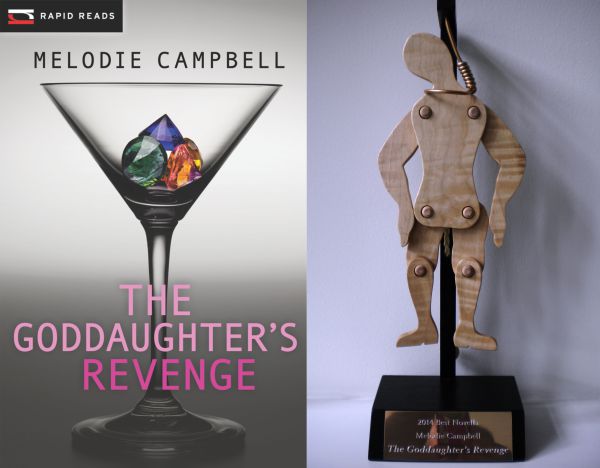
Winner of 9 awards, including the 2014 Derringer
and the 2014 Arthur Ellis (Canada) for The
Goddaughter’s Revenge (Orca Books), Melodie has over 200 publications,
including 100 comedy credits, 40 short stories, and seven novels. She teaches
Crafting a Novel at Sheridan College, and is the Executive Director of Crime
Writers of Canada.