I'm paraphrasing Jane Friedman here, when I say:
"Success takes a million tiny steps."
People always ask me what's the hardest part of being a college fiction writing teacher. Is it all the tedious marking? Having to read beginner attempts at writing in genres you don't want to read? The long hours teaching at night, at the podium?
I don't teach that way (at the podium.) I'm a desk-sitter. But it's none of that.
By far, the hardest part of being a writing instructor is telling my students about the industry. And in particular, that they aren't going to knock it out of the park with their first book - the one they are writing in my class.
It's hard, because they don't want to believe me. Always, they point to one or two authors who make it to the bestsellers list on their first book. "So and so did it - why won't I?"
What they don't know is that the book on the best-seller list - that author's "debut novel" - is most likely NOT the first book the author wrote. Industry stats tell us it will likely be their 4th book written. (3.6 is the average, for a traditionally published author.)
My own story works as an example. My first novel published, Rowena Through the Wall, was a bestseller (yay!) But it wasn't my first novel *written*. It was my third. And before that, I had 24 short stories published, which won me six awards. (Six awards, students. Before I even tried to get a novel published.)
Each one of those short stories, each of those awards, was a tiny step.
About that first novel: it was horrible. So horrible that if anyone finds it on an abandoned floppy disk and tries to read it, I will have to kill either them or me. It was a Canadian historical/western/romance/thriller with a spoiled, whiny heroine who was in danger of being killed. No shit. Even I wanted to kill her. The second book was also horrible, but less horrible. It was a romantic comedy with a "plucky heroine" (gag) and several implausible coincidences that made it into an unintentional farce.
By the time I was writing my third and fourth novels, I got smarter. Apparently, I could do farces. Why not deliberately set about to write a humorous book? And while you're at it, how about getting some professional feedback? Take a few steps to become a better writer?
I entered the Daphne DuMaurier Kiss of Death contest. Sent the required partial manuscript. Two out of four judges gave me near perfect scores, and one of them said:
"If this is finished, send it out immediately. If this isn't finished, stop everything you're doing right now and finish it. I can't imagine this wouldn't get published."
One more tiny step.
That book was The Goddaughter. It was published by Orca Books, and the series is now up to six books. (Six steps.) The series has won two awards. (Two more steps.)
I'm currently writing my 18th book. It comes out Fall 2019. Last summer, for the first time, I was asked to be a Guest of Honour at a crime fiction festival. It may, just may, be my definition of success.
If you include my comedy credits, I have over 150 fiction publications now, and ten awards.
160 tiny steps to success.
Conclusion: Don't give up if your first work isn't published. Take those tiny steps to become a better writer. Take a million.
Showing posts with label novel writing. Show all posts
Monday, 30 April 2018
Tuesday, 4 August 2015
IWSG Day! My Novel is a Mess (How to survive the chaos point in your novel)

Welcome IWSGers!
Is your novel ever a mess?
By Melodie Campbell (Bad Girl)
Yes, I’m at that point.
Writing to a specific word count, three-quarters written, and my eleventh
novel is an unqualified mess.
If you are a veteran writer like me, you say it’s not going
to happen this time. But it does.
EVERY
FREAKING TIME.
Here’s why:
The Linear Approach:
This time, you are going to write linear, by gawd. One chapter after another, in mathematical
order, until you reach the end. Each
chapter will have an outline.
But here’s the problem with that. You signed a contract that specifies a pretty
exact word count. Is your story going to
magically end at the precise word count you need?
Damn straight, it’s not.
It’s going to meander along, minding its own business, taking little
side trips, refusing to stay on course.
Because, of course, outlines are just that. They’re a guide. You don’t know whether the story is really
going to pull together with sufficient motivation and all the goodies until you
actually write the thing. And here’s
what happens along the way:
You need a new character to make the plot work. You just thought of a fab new subplot. Orlando doesn’t work as a side-setting. You need to move it to Phoenix, and that
means a whole lot of changes…
And before you know it, you’re scribbling on the outline,
adding this, subtracting that, and it hits you in the face. Your book is a mess.
Scene plus Scene
I write comedy, and comedy is finicky. Those good lines come when they come, and you
have to get them down fast. Sometimes
they’ll present themselves to me when I’m in a restaurant. Sometimes, when I’m already in bed. (Yes, I keep a pen and paper on my bedside
table. Ditto, by the loo.)
I always have an outline.
But when writing a highly comedic book, you have to write those funny
scenes when you are inspired. This means
hopping around the timeline, writing the scene that works for you today,
thinking of another great line, hopping back to an old scene to insert it, when
you should be moving forward.
Which brings you to this point: the important scenes are
written, and they present themselves like completed sections of a jigsaw
puzzle. Little isolated islands without any bridges to each other. You need to find the pieces that are
missing and write the bits to connect them.
Because Sister, your novel is a mess.
That’s the point I’m at now.
The comedy is there. The
conflicts are in place. The climax is
written. Now I need to take that kaleidoscope
and move those pieces into the pattern that works best.
How to cope? I think
the best thing you can do is accept that this is going to happen. Unless you are a robotic automaton lacking
inspiration, you are going to veer from the plan more than once.
At some point, every novel you write is going to be a
mess.
My advice: just accept it.
And understand that part of your role as writer is that of clean-up
artist.
That’s where I stand today, staring at a story that looks
like a tornado just ran through it.
Time for the cleanup crew. And a healthy wee dram or two.
Visit more great IWSG day posts through this link:
http://www.insecurewriterssupportgroup.com/p/iwsg-sign-up.html
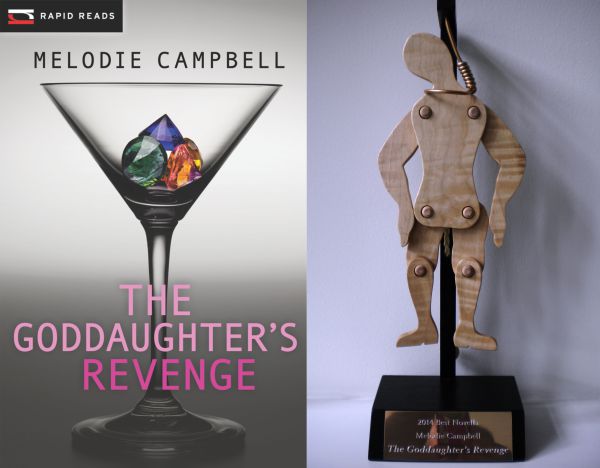
Melodie Campbell writes funny books, including the multi-award-winning The Goddaughter's Revenge. She would feel much more secure if you would buy it. For a sneak peek, Click here
Sunday, 19 January 2014
The Seven Things You Need to Become a Writer by Melodie Campbell (Bad Girl)
Stepping away from comedy for a moment to talk about that favourite
topic: How to become a published writer.
I have over 200 publications, 9
awards, and have taught fiction writing since 1992. Based on my experience with over 1000
students, here is my abridged list of what you need to become a writer:
1. Time.
Writing takes time. To be a
writer, you are going to have to give up something. I gave up television and the gym. The latter is obvious.
2. A room to write.
Virginia Woolf said: A woman needs
money and a room of her own in order to write. EVERYONE needs a room, or a place to
write. Preferably with a door to close
out the rest of the world. Especially if
you have kids. I wrote in the bathroom
for years.
3. Supportive friends.
Eliminate all people you can from your life who are negative influences
on your writing. The ones who think you
will never make it. The ones who think
it’s a ‘cute’ hobby. The ones who look down upon the genre in which you
write. Do it now. This minute. Become friends with other writers who share
your passion.
4. Desire.
I nearly said passion, but really, they are the same thing. To be a writer, you have to actually love to
WRITE. That is, bum in the chair, by
yourself, hitting the keyboard, in a world of your own making. Too many people want to become authors, but
don’t actually like the physical work of writing. Figure out whether you do right now.
5. The Craft.
If you want to write a novel, take a course in crafting a novel. If you want to write short stories,
ditto. You’ll learn a lot really quick,
and it will cut years off your apprenticeship.
Not only that, you’ll make friendships with like minds who will inspire
and encourage you.
6. Talent.
Yes, you need talent. By that, I mean you need plot ideas of your
very own. I can teach you the craft of
writing in my college fiction writing classes.
But you also need to have the sort of brain that is producing ideas all
the time. Successful fiction writers
don’t have to look for ideas. They are
drowning in them.
7. A Thick Hide.
All
writers deal with massive amounts of rejection.
Even when you strike gold and get a publisher, you will deal with
rejection in the form of bad reviews on Amazon and Goodreads. None of us escape that. All of us need to develop a thick hide to
survive as authors.
Luckily, I have developed a thicker
hide. It comes from skipping the gym and
gaining weight.
Subscribe to:
Posts (Atom)