Sunday, 22 December 2019
Have a Confusing Christmas!
(First published in The Sage Magazine, 2015)
The following story is true. And it may explain the slightly manic sense of humour that has informed my years as a comedy writer.
For most of my life, I have been confused about Christmas.
This is because I am the quintessential Canadian mutt. Four parts Italian, one part Irish, one part English, one part Chippewa, and the final bit was a surprise, at least to me. It overlaps with the English connection (wait for it.)
The Italian part is easy to explain. Mom came from Italy with a whole bunch of relatives. In fact, ‘relatives’ were the main export of that small town outside Palermo, outranking olive oil for several decades. They brought with them a wonderful love of food and wine and laughter from the old country. Unfortunately, they didn’t bring a lot of good taste.
Every year, my Sicilian grandmother would put the plastic lighted crucifixes (made in Japan) in glaring rainbow colours, on the Christmas tree. I was a bit confused by that, not only because it was gawd-awful tacky and fought with my budding interior designer. But the part in the Ten Commandments about ‘no graven images’ seemed to be at risk here.
Nevertheless, we all looked forward to the blazing orange, green and red crucifixes, unaware that it was a sort of macabre thing to do to a Christmas tree. Did I mention Halloween is my favorite holiday?
The Chippewa part of our family tree was a tad more elusive for me to discover. We lived in 1960s Toronto, after all. One didn’t notice a lot of diversity in suburban Don Mills at that time. However, some of our family rituals seemed to be a little different from those of my school chums. They started to point this out.
I first got a hint that there might have been First Nations blood in our family when someone asked why we put ground venison in our traditional Christmas Eve spaghetti sauce. True, we had a freezer full of deer, moose, salmon, and not much else. Later, it occurred to me that I actually hadn’t tasted beef until I was ten, when for my birthday, Dad took us to the A&W for a real treat.
“This tastes weird,” I said, wrinkling my nose.
“That’s because it’s made from cow,” Dad said.
Of course, if I had been more on the ball, there were other clues. But at the age of six, you don’t necessarily see things as out of the norm. What your family does is normal.
That summer in Toronto, I loved day camp. They split us kids into groups named for First Nations tribes. By happy coincidence, I got placed in the Chippewa tribe. When I got home and announced this, the reaction was: “Thank God it wasn’t Mohawk.”
The camp leaders were really impressed with my almost-authentic costume. (Everyone else was wearing painted pillow cases.)
But the real confusion about Christmas and my provenance came many years later.
I spent most of my life not knowing we were part Jewish. I was about forty, when the designer shoe (a bargain on sale at David’s) finally dropped. Dad and I were eating pastrami on rye at Shopsy’s Deli one day (which we did on a regular basis, once a month – a reasonably intelligent person might have considered this the first clue) when Dad wiped a drip of mustard off his face and said:
Dad: “I haven’t heard from my cousin Moishe Goldman in a long while.”
Me: “We have a cousin named MOISHE GOLDMAN??”
Of course, if I had been thinking, all this made sense. We had lived in a Jewish neighbourhood. Our frightfully English family name was apparently Hebrew for ‘antelope.’ And I was only the only kid in school who got Halvah in their Christmas stocking every year. (Damn straight. I really did. I still do.)
So I’m hoping this may explain why we have a five foot lighted Christmas peacock on our front porch this year, and a lighted Christmas palm tree in our back yard. “A Peacock in a Palm Tree” may be confusing to you folk who know the song and are expecting a partridge with pears, but to those of us who have been confused about Christmas all our lives, it is mere icing on the proverbial Kugal.
Wednesday, 18 December 2019
Many thanks to CM magazine for this 4 Star review of the YA book Crime Club!
"Crime Club is a fast-paced read with few breaks from the action…. the reader is given a good sense of who Penny is and what motivates her. Her close relationship with her dog Ollie also provides some depth to her character. Crime Club is written in a simple and straightforward way with short sentences and an easy vocabulary, making it an excellent choice for a struggling reader or a reader learning English. The fast pace and plot focus will also please any reader looking for a quick mystery read.
Recommended"
Wednesday, 27 November 2019
Great news! It's a GREAT READ!
Woke up to find THE GODDAUGHTER DOES VEGAS is on the FOREST OF READING 2020 GREAT STORIES list,
sponsored by the Ontario Library Association!
Many thanks to the Forest of Reading committee, and their readers who made this happen! This is book six in the Derringer and Arthur Ellis award-winning caper series. Gina and the gang in Hamilton and Vegas will be thrilled.
sponsored by the Ontario Library Association!
Many thanks to the Forest of Reading committee, and their readers who made this happen! This is book six in the Derringer and Arthur Ellis award-winning caper series. Gina and the gang in Hamilton and Vegas will be thrilled.
Saturday, 9 November 2019
Authors Don't Give Away Your Age!
Let’s face it: by the time most authors get their groove on (oh wow –
*slap* on the wrist, Bad Girl, for that telling expression) they aren’t
spring chickens. From stats I’ve seen, most authors get their first
book published in their 50s or 60s. I was 49, I think. (The first
novel came after 40 short stories.)
But publishers would have it different. It’s the old, “I want a 21 year old with a PHD and 15 years experience” syndrome. It’s a crummy fact. Younger authors are better for a house than older authors, as said older authors will not have as many writing years left. My agent told me that I was ‘okay’ at 49. Had I been older, his advice was “keep it to yourself. And keep dyeing the hair.”
So it’s in an author’s interest not to appear retirement age. Why, then, do so many mature but newbie writers give themselves away?
No need to be careless. Here’s the advice I give my Crafting a Novel Students:
Names: Recently, I read a mystery book where the protagonist was named Dorothy. She was supposed to be 35 years old. Now, I may be over 35. (Okay, by a good 20 years.) *No* one in my age group was named Dorothy. In fact, I don’t know a Dorothy under age 65. What I *do* know is something about the author. Not only must she be over 65 (and she is), but she didn’t do her research.
Helen, Jean, Phyllis, Mildred: That’s my mother’s generation.
Linda, Debbie, Carol, Cathy: Baby Boomers
Tiffany, Jennifer, Alex, Natalie, Caitlin: Echo-Boom
You can look them up online (popular names for each decade.) And okay, it’s not a hard and fast rule. But when we see certain names, they automatically bring to mind people of a certain age. Yes, someone can be named after a grandmother. But unless you explain it (or describe the person immediately) we are going to have a picture in our minds.
What it does reveal in painful technicolor (*slap* again) is that the author is a generation or two older than her protagonist. Do you want a publisher to know that? No you don’t.
Cell phone: If you are writing a current day novel, your protagonist is gonna be glued to her cell phone. And she won’t be phoning. Nope, she is going to be texting like crazy. I am blown away by the number of older authors who have their 30 year old protagonists picking up the cell every five minutes to *talk* to someone. Really? Do you *know* any 30 year olds? Talking on the phone went out with cassette tapes and big hair. Young folk don’t call anymore. Only their fingers work. In my latest book Crime Club (which is YA) my teens use dialogue in person, but text each other as soon as they are alone. Yes, in a book. You can make it interesting. But for Gawd sake, make it real.
And about time settings: If you are writing a book that takes place in the 60s 70s or 80s, you are immediately dating yourself. Yes, it’s convenient not to have to worry about cell phones. But publishers tell us there isn’t a market for books set in those decades yet. Historical ends at 1950 so far. So if you are writing in those decades mentioned, we all know you are probably a nostalgic 60 plus type.
Music: If your protagonist is 20, and she is bouncing along to Glass Tiger, or Fine Young Cannibals (my music) you had better find a way to explain it. That’s what her parents listened to. Even worse, the Beatles. That’s almost grandparents. Regularly, I find 65 year old writers having their 30 year old protagonists listening to music that went out in the 70s. And I hear authors say, when I question them, “Maybe she’s into retro.” Yeah, and maybe the author is 65 years old and doesn’t know what is current.
Do what I did in The Goddaughter. Research what is current. Gina’s smartphone sings “Shut Up and Drive.”
Machine gun bonus: In class last term, I was explaining the above phone choice I made for Gina back some years ago, and couldn’t remember the name of the artist who sang the song. One of my students said, “I’ll ask Siri.” A minute later, she was giggle like crazy. “I put in ‘Shut up and Drive’,” she told the class. “Siri answered: ‘That’s not very nice’.”
Welcome to our Brave New World.
But publishers would have it different. It’s the old, “I want a 21 year old with a PHD and 15 years experience” syndrome. It’s a crummy fact. Younger authors are better for a house than older authors, as said older authors will not have as many writing years left. My agent told me that I was ‘okay’ at 49. Had I been older, his advice was “keep it to yourself. And keep dyeing the hair.”
So it’s in an author’s interest not to appear retirement age. Why, then, do so many mature but newbie writers give themselves away?
No need to be careless. Here’s the advice I give my Crafting a Novel Students:
Names: Recently, I read a mystery book where the protagonist was named Dorothy. She was supposed to be 35 years old. Now, I may be over 35. (Okay, by a good 20 years.) *No* one in my age group was named Dorothy. In fact, I don’t know a Dorothy under age 65. What I *do* know is something about the author. Not only must she be over 65 (and she is), but she didn’t do her research.
Helen, Jean, Phyllis, Mildred: That’s my mother’s generation.
Linda, Debbie, Carol, Cathy: Baby Boomers
Tiffany, Jennifer, Alex, Natalie, Caitlin: Echo-Boom
You can look them up online (popular names for each decade.) And okay, it’s not a hard and fast rule. But when we see certain names, they automatically bring to mind people of a certain age. Yes, someone can be named after a grandmother. But unless you explain it (or describe the person immediately) we are going to have a picture in our minds.
What it does reveal in painful technicolor (*slap* again) is that the author is a generation or two older than her protagonist. Do you want a publisher to know that? No you don’t.
Cell phone: If you are writing a current day novel, your protagonist is gonna be glued to her cell phone. And she won’t be phoning. Nope, she is going to be texting like crazy. I am blown away by the number of older authors who have their 30 year old protagonists picking up the cell every five minutes to *talk* to someone. Really? Do you *know* any 30 year olds? Talking on the phone went out with cassette tapes and big hair. Young folk don’t call anymore. Only their fingers work. In my latest book Crime Club (which is YA) my teens use dialogue in person, but text each other as soon as they are alone. Yes, in a book. You can make it interesting. But for Gawd sake, make it real.
And about time settings: If you are writing a book that takes place in the 60s 70s or 80s, you are immediately dating yourself. Yes, it’s convenient not to have to worry about cell phones. But publishers tell us there isn’t a market for books set in those decades yet. Historical ends at 1950 so far. So if you are writing in those decades mentioned, we all know you are probably a nostalgic 60 plus type.
Music: If your protagonist is 20, and she is bouncing along to Glass Tiger, or Fine Young Cannibals (my music) you had better find a way to explain it. That’s what her parents listened to. Even worse, the Beatles. That’s almost grandparents. Regularly, I find 65 year old writers having their 30 year old protagonists listening to music that went out in the 70s. And I hear authors say, when I question them, “Maybe she’s into retro.” Yeah, and maybe the author is 65 years old and doesn’t know what is current.
Do what I did in The Goddaughter. Research what is current. Gina’s smartphone sings “Shut Up and Drive.”
Machine gun bonus: In class last term, I was explaining the above phone choice I made for Gina back some years ago, and couldn’t remember the name of the artist who sang the song. One of my students said, “I’ll ask Siri.” A minute later, she was giggle like crazy. “I put in ‘Shut up and Drive’,” she told the class. “Siri answered: ‘That’s not very nice’.”
Welcome to our Brave New World.
Friday, 1 November 2019
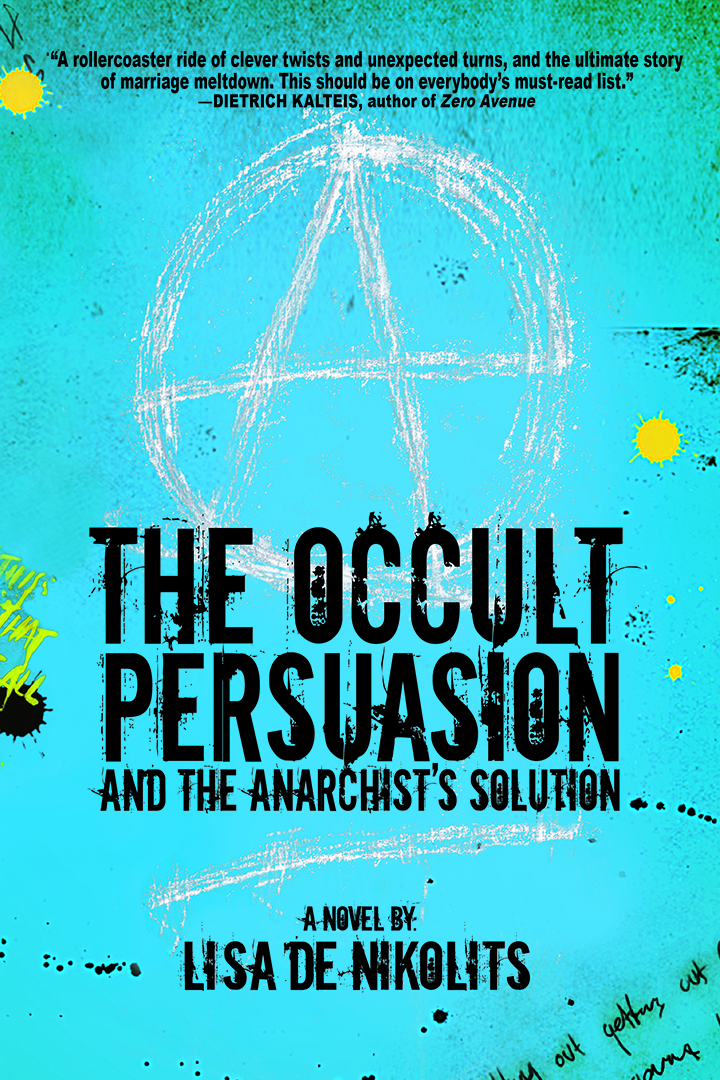
Say hello to Lisa de Nikolits, author of the intriguingly titled THE OCCULT PERSUASION AND THE ANARCHISTS SOLUTION!
It's my pleasure to welcome back Lisa de Nikolits to the Bad Girl Blog! Lisa and I are both members of the Mesdames of Mayhem, which gives me an opportunity to announce yet again:
CBC Mini-Documentary! THE MESDAMES OF MAYHEM, now showing on GEM, and Youtube.
Both Lisa and I are featured authors on the doc, and in fact, I follow Lisa in the filming, as you will see. Watch it, and learn how both of us come to be crime writers from rather unique backgrounds.
So! Lisa - your ninth book has just come out, The Occult Persuasion and The Anarchist’s Solution! Kick off by telling us a bit about the book.
LDN:Thank you for having me! I’d love to! The Occult Persuasion and the Anarchist’s
Solution is about a couple experiencing a crisis. The husband, Lyndon, loses his job as editor of a financial magazine. Neither are happy
with aging. Lyndon has gotten by with charm and frozen emotions.
The
wife, Margaux, has no idea how angry she is with him for his
detachment. It is her idea to sell the house and just travel. But he is
not coping well with retirement,
so he simply walks off a ferry in Australia and leaves her. He steals a
cat (well, he steals an expensive SUV that happens to have a cat
onboard) and he flees Sydney, ending up in Apollo Bay, a few hours
south-west of Melbourne, where he falls in with a group
of anarchists and punk rockers in a tattoo parlour, planning
revolution.
Meanwhile,
Margaux sits tight in Sydney with no idea of where her husband might be
or what happened. She moves into the red-light Kings Cross area,
befriending
the owner of the hostel, a seventy-year-old ex-cop drag queen from
Saint John, New Brunswick, and waits to hear from her husband.
When
she learns that her husband is fine, she is consumed by wrath and she
invokes the angry spirit of an evil nurse, a key player in the terrible
Chelmsworth sleep
therapy in which many patients died (historical fact). While Lyndon
gets in touch with his original career ambition to become an artist and
wrestles with anarchism versus capitalism, Margaux learns to deal with
her rage.
A serio-comedic thriller about a couple who embark on an unintentionally life-changing around-the-world adventure, The Occult Persuasion and the Anarchist’s
Solution is about the meaning of life, healing from
old wounds, romantic love at all ages, and how love and passion can make
a difference, at any age.
MC:
Whoa, that sounds like quite the ride! You label the book as
serio-comedic. As you know, when I teach comedy writing classes, I always say: tragedy is the root of all comedy. So your term serio-comedic is truly fitting. Did you set out to write a funny book or did it just
work out that way?
LDN:
The funny (pardon the pun!) thing with my books is that they pop out
infused with humour but humour was never my intention. I have a rather
dark way of viewing
the world and fortunately, it finds a humorous voice as opposed to a
bitter or dark one. I guess, in the same way
that a lot of comedians are quite sad or depressed people and express
their views in comedy, my way of setting a scene,
and the characters, comes out in a funny way.
MC: A rather dark way of viewing the world? Yes, I see that in your work. You want to elaborate on that?
LDN:
I wish I could say that I have a cheery view of man and (wo)mankind but
I don’t. Spurred on by the seven deadly sins (and a few that haven’t
even made the
list yet!), we repeatedly err as we traverse this journey
of life. It seems to take more effort to do good than bad! I’m not sure
why that is. So yes, I do have a dark view and that’s what comes in so
handy for crime writing and for crime writing
infused with humour.
MC: We crime writers definitely look at the dark side of humanity for our plots. But I'd say your take is unique. I like your lens. Tell us more.
LDN: Well, for example, take The Occult Persuasion.
I had this guy running away from his wife. He’s having a mid-life
crisis, decides to up
and leave in the middle of a foreign country. And what happens next? He
cat-naps a great feline! I didn’t see that coming as a plot twist but
when it did, I thought it was really funny. Funny and endearing. I mean
who doesn’t relate to a guy who loves an animal?
To that point in the book, Lyndon, the runaway husband, hasn’t been a
really relatable kind of guy but wham, he steals a cat! And he falls in
love with it!
MC: Perfect. Totally unexpected, and yet so valuable in ensuring that the reader comes to care about what happens to Lyndon. Comedic elements do help create empathy, don’t they?
LDN:
Exactly! There’s a scene in the washroom where the wife is having a
meltdown in the washroom and it’s very funny too. You really feel for
her. And it’s like
one crazy event leads to another and it all builds the tension and
suspense. So, as well as helping create empathy and move the plot,
comedy keeps the reader engaged. And, comedy offers the readers a moment
to enjoy life even when the characters are dealing
with dark aspects like demonic possession, marriages imploding, grown
up kids having their own crises and being lost in a strange country.
MC: In your books, I really see how humour helps to release the tension that is building and building. Too much tension, and the reader is overwhelmed. I call you unique as a writer, Lisa, but I can also see how you could be compared to some names we know. How would you
characterize your own books? Just so readers can get an idea of what to
expect?
LDN:
My books have been compared to Christopher Moore and even Stephen King
but with humour. I’d say they are Tarantino-esque, in a Pulp Fiction
kind of way. I
think that’s my natural style, the serio-comedic style and I work very
hard to come up with original ways to grip a reader and offer them
something new. I am definitely not a cozy writer although I often wish I
were! But then one often wishes one could write
in a different style but you write what you write. Which is not to say
you can’t improve – I work every single day to improve as a writer but
it’s like you’re stuck with your writing style, in a way, kind of like
your own personality. LOL, there are quite
a few things I’d like to change about my personality, for example, if
there’s a such a thing, I try too hard! I’d like to try a bit less hard
and care a bit less but I can’t! And in the same way, you can work at
your technical skill but the essence of one’s
writing is what you’re born with.
MC: I'll drink to that. (Where's my scotch?) I truly believe that being a writer is something we have to do, or we go mad. All those characters fighting for places in our brains have to be let out to party. Lisa, this is book nine. Have all nine books been serio-comedic?
LDN:
Good question! Actually, no. The Nearly Girl and No Fury Like That were
but Rotten Peaches was more noir. The Nearly Girl came after Between
The Cracks She
Fell which wasn’t funny and then readers were surprised and a bit taken
aback by the humour. Then, after No Fury Like That, Rotten Peaches came
out and readers said “where’s the comedy? Why so dark?” Although some
readers found Rotten Peaches very funny! So
I never know what to tell people. I feel like if I tell them to expect
one thing, that then I might fail them when they read the book and they
might think “oh, it’s not that, at all!” So I prefer not to categorize
or describe my books (I totally suck at the
elevator pitch!) but just say to readers that if you’re in the mood,
you’ll love my books and if you’re not, then maybe try them another day.
Sometimes you’re in the mood for one thing and not another but it
changes! So all I ask of readers is to give the
books a chance – I do promise to give a rolicking good ride and a story
full of originality and depth!
MC: And that you do. As I said, Lisa, you are an original, and someone to be celebrated. Anything else you wish to add?
LDN:
Thank you very much for having me a a guest today and may I add that I
love all your books, no matter what day or what my mood is! In fact, if
my mood is glum,
then your books lift me up! So thank you for all the good reads!
Ditto, my friend.
Saturday, 26 October 2019
CBC Mini-documentary THE MESDAMES OF MAYHEM
Now airing on GEM!
The CBC Mini-documentary THE MESDAMES OF MAYHEM
(Featuring Canadian Women Crime Writers, including Melodie Campbell)
I like when they darken the film...those of us associated with crime like to live in the shadows...
The CBC Mini-documentary THE MESDAMES OF MAYHEM
(Featuring Canadian Women Crime Writers, including Melodie Campbell)
I like when they darken the film...those of us associated with crime like to live in the shadows...
Friday, 25 October 2019
Subscribe to:
Posts (Atom)